skip to main |
skip to sidebar
 We are connected! Our photovoltaic array has been installed for several weeks, but has been sitting there on our roof completely uselessly until the electricity company, ENEL, came to connect it all up. This they finally did last last week, a day of great excitement, and now we are our own little substation, generating electricity during daylight hours and feeding it into the national grid.
We continue to use electricity drawn from the grid – so when there’s a power cut, we still go dark, despite the high-tech array above our heads – which seems perverse but saves us having to set up an enormous quantity of batteries to store the electricity the panels generate, and is also the only way we get the government subsidy. The subsidy, or “incentives” as they call it, runs for twenty years and allows us to take out a loan to pay for the panels and to pay it back over ten years using the income from the incentives, meaning that the second period of ten years will be all profit (though we’re not talking huge sums here, and neither is it inflation-linked). The principal benefit to us will be that we’ll no longer have to pay an electricity bill, which will be a great relief as prices go up and up.
The greater and infinitely more significant benefit of course is that by not using fossil fuel-based electricity we are avoiding C02 emissions and thus helping a tiny bit in the fight against global warming. This feels good.
We're talking about the weather again, a far-away friend of mine said to me recently… Like that was something bad, or boring, or we couldn’t think of anything better to talk about (though we had lots to talk about in fact, and the weather was our subject of choice). And it’s true that the weather is a staple topic of conversation and it’s often what people talk about, well, when they haven’t got anything better to talk about. But it’s also true that – and I’ve noticed this especially since living in the country and having animals and growing vegetables – the weather is: interesting. Really, it is.
You seem to have a lot of weather out there, this same friend said, and I laughed. A lot of weather? But yes, it’s not the stable, hot, same-day-after-day Mediterranean summer climate that I thought it would be when we moved here. Maybe this is something to do with climate change, who knows? Two days ago it was baking hot and we couldn’t move for the heat; yesterday it was still very hot but there was a strong wind all day – the scirocco, the hot south-west wind that blows straight from Africa and dries all our plants to death. Murderous as it is, we hate the scirocco at this time of year. Overnight there was unexpectedly a huge, thundery rainstorm. (We’d left the skylights open and I’d hadn’t shut the car windows either.) This morning was grey and cloudy but the air was uncommonly still. I took the horse for a workout in the ring with one of our current guests, a 14-year-old girl, and we got caught in another rainstorm that blew up and passed over. The horse pranced about a lot in the wind and rain but managed not to totally lose it, and after 15 minutes or so the sun came out again and the breeze dropped (and the horse calmed down). And late this afternoon I was out in the ring cutting down the tall weeds with a sickle, and a strong persistent wind got up that was blowing from the east (that’s Siberia, pretty much) and was positively chilly. As I write this it’s barely 14 degrees, almost unheard of in July, even at 10pm.
So that is a lot of weather in a short few days.
And it’s a staple topic of conversation, especially in the country, because it’s a significant force, perhaps the most elemental of all. It affects everything you do and so much of what your life revolves around: no rain at all, you lose half your tomato crop; too much rain in May, you lose your hay; late frost, no cherries; strong wind, half your figs are blown off the tree (that happened today).
So. Weather. There’s a lot to talk about.
 This is the season of Really Big Machinery. The farmers are getting in the second-crop hay with the tractor/mowers, and the corn and barley harvest is in full swing. For this they bring out the big guns – the combine harvesters.
Before I lived here I didn’t, for perhaps obvious reasons, think about combine harvesters much. In fact I still don’t think about them very much, but this is their season and it’s hard to avoid them. And they are incredible, amazing, really very, very large beasts indeed. They are itinerant and travel from farm to farm for the harvest, and meeting them on the tiny, narrow country roads is a scary business. They dwarf everything around them. They even dwarf the big tractors pulling the big trailers carrying various other big bits of combine-harvester supplementary equipment. They are wide and long and tall and bulky, an inelegant, awkward, asymmetrical shape, with a cab high up near the treetops, and surprisingly small wheels. Their sheer size inspires awe, especially in someone driving a Fiat Panda. You see them on the roads moving in a slow convoy, a tractor/trailer first and then the combi and then the lorry that the harvested grain is spewed into, the whole preceded by a jeep with someone waving a red flag to let oncoming traffic know there’s something to be taken seriously on the road ahead.
And yet in the fields they are almost nimble and so perfectly fit-for-purpose. They pass up and down the rows of corn with unrelenting straightness. On these steep cultivated hillsides, they are balanced in such a way that they can drive laterally along the slope, one set of wheels higher than the other, and yet the cab remains horizontal. This is amazing to someone like me with absolutely no concept of how such a feat could be achieved.
They are little worlds in themselves: some of the new ones have air conditioning, fridges and sound systems.
Round here we see two or three regulars every year: a slightly elderly, rickety red one, a grasshopper-green one, and a huge new, swanky, dark-green one. You can see them working in a field from miles off, by the cloud of dust that is raised around it as they work. Tractors, lorries and heavy-duty off-roaders wait in attendance by the side of the road. I read on the internet that it costs about £700 at the moment to fill up a combi with red diesel (the subsidized diesel that farmers use), and that this is enough for a single day’s work.
A rather fabulous thing about them is that they work at night, too. In the ferocious summer heat the farmers often save their tractor work till evening when it’s cooler and continue into the night, working by the light of their headlamps. Looking out over the valley you’ll see little sharp pools of light beetling their way across the slopes under the stars. They look lonely, but purposeful and industrious. Driving late at night I stop at the sight of a combine harvester working like this in a dark field, all lit up like some alien craft just touched down out of the sky. I watch the slow power of its progress for a while, and then drive home.
 The ducklings are fine: growing apace and living quite happily in the pen. Overnight they go into the duck house with the big duck and they now seem to coexist together without any friction. Interestingly, a few days ago our current guests witnessed the big duck flapping about outside the pen to frighten off some predatory magpies that were chattering around too near the ducklings - so her maternal instinct has finally switched itself on!
The little ones are still very sweet to watch, with their fluffy downy feathers gradually shedding now as their adult feathers come in. They are very, very nervy and run away in their little group if you go too close, or when you change their water or feed them or adjust the sheet over the pen that shades them from the sun. Then they stand very still, listening, until they decide that they are safe, and one by one they sit down, which they do with a kind of folding, collapsing motion of their legs. I don't remember the first lot of ducks we had being this nervous, but maybe they were. We'll let them out into the big wide world soon, under supervision and with Maxim the duck-eater well out of the way.
Nothing more to report on ducks right now.
Finally decided to plant out the onion sets that I bought weeks ago, hoping they hadn’t died in the meantime. They looked brown and small but not completely dead. At 9.30 in the morning it was already very hot, in the high 20s, so I slathered up with sun protection and headed down before the full onslaught of the heat.Hacked my way through the knee-high jungle of weeds that just a couple of weeks ago was a pristine area of fine tilth. With the luxury of the new rotovator (motozappa) we have made the veg patch very big this year, and it turns out to be too big – vast acreages of space in between individual plants or groups of plants, which has allowed the weeds to flourish. That and the weeks of rain in late May/early June, followed by this heat – it has all led to the growth of a sort of miniature tropical forest.Anyway, back to the onions. I hoed three nice furrows in which to plant them, hauling out tonnes of weeds as I went. Couch-grass infestation is the worst, with endless tough roots that are practically impossible to pull out fully. I managed to put in the little onions, ten per row, and then had to hoe another row for the remainder, I seem to have about 40 in all. Watered them in. And I hope they will survive. They look very tiny and I think it’s too late in the season, really, to be planting out onions, but we’ll see.The tomatoes meanwhile have also suffered neglect but have enjoyed it and flourished like crazy. Each main stem had put out three or four strongly growing side shoots; even the side shoots had side shoots. All these shoots should have been pinched out weeks ago as soon as they appeared but we failed dismally on that. Now the plants are so green and strong and healthy it seems a shame to take off the extra shoots, but that’s what has to be done so that they grow tall and put their energy into producing fruits now, and so I spent a bit of time doing that and enjoying breathing in the pungent greeny smell that tomato plants give off when you break them.Finally and exhaustedly I did a bit more obsessive weeding and hoeing around the self-seeded dill that has sprung up all over the place, and by the end of this it was midday and I was hot as hell and drenched in sweat and dying for a drink of water. In this weather this kind of work needs to be done before 10 am and you definitely need a siesta after lunch. Some hope.We found out recently that the local contadini (farmers) know how to tell the year’s weather using onions, by peeling off the layers of onions at the beginning of each year and somehow using them to forecast fairly generalized weather predictions for the whole year ahead. They got it right at Easter, when during a warm spell I was told that “next week it will snow – the onions say so”. How we scoffed; how right they were. And now they are saying that after a hot July the weather will break and the rest of the summer will be lousy – let’s hope the onions will be wrong on that one.
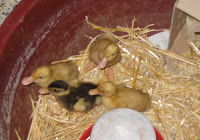 We have had the ducklings for ten days or so now and they’re about three weeks old. At night they live in a tub in the spare room lined with newspaper and straw, and in the mornings we put them out into the enclosed duck-pen. It’s incredible how smelly four little ducks can make a room in twelve hours. They’re eating chick starter feed and getting through not as much water as I’d have expected given the heat. During the day they huddle in their little group in the shade with occasional forays – all together – to their drinking water or their feed. They move as one. They rootle in the grass and I’ve seen them catching bugs and insects. Good ducklings. They are just about big enough now to poke their beaks over the edge of the washing-up bowl that serves as the big duck’s bath, and they’re trying to drink from that but without a great deal of success.
In all, they are very very cute indeed but I hope they can live outside soon as the moving them to and fro every morning and evening is a pain and so is the smell. This all depends on the big duck now – we have put her in the pen a few times together with the ducklings to try to get them used to each other, and she hasn’t actually attacked them, but she’s not very happy being with them and paces up and down along the wire like a caged, er, duck. I’d never have thought a duck could pace, but she is definitely pacing. This is a duck we’ve had for two years, one of our original four, the others having been lost through a process of natural attrition (otherwise known as the fox. And the puppy). Since Christmas, when the last two ducks were brutally torn from us, this duck has hung out with the dogs, Teo and Maxim, in a very sweet and strange little threesome. Teo is totally laid back about the situation (possibly he hasn’t even noticed) – the duck follows him everywhere and when he lies down, she does too, and when he goes off to bark at something in the distance, she goes too and stares off intently into the same distance, seemingly on the very point of barking. Maxim is somewhat more bothered, he being the one that killed the first duck and now living in fear of retribution; this duck tries to nick food from his bowl, and you can just see Maxim’s torment as he suppresses his natural canine instinct to rip her throat out and meekly backs away. The upshot of this is that the duck basically seems to think she’s a dog, which is why we’re not sure what her reaction to the ducklings is going to be. Apart from, so far, confusion – “What are these little things? They’re not puppies. Get them away from me.” I wouldn’t like to shut the ducklings in with her in the duckhouse overnight in case we opened the door in the morning to baby-duck carnage.
Later
So: tonight's the big night and we’re putting the ducklings in their tub and leaving it (covered) in the enclosure, with the big duck shut in the attached duckhouse. So the little ducks get a chance to experience night in the big wide world, and the big duck gets used to having them in her territory.
Come the morning, we will know all.
 We are connected! Our photovoltaic array has been installed for several weeks, but has been sitting there on our roof completely uselessly until the electricity company, ENEL, came to connect it all up. This they finally did last last week, a day of great excitement, and now we are our own little substation, generating electricity during daylight hours and feeding it into the national grid.


